
How Lithium-Ion Battery Packs Work — 18650, 21700 Cells Explained
Lithium-ion cell chemistry (NMC, LFP, NCA), 18650 vs 21700 form factors, series vs parallel packs, BMS function and thermal runaway safety.
Contents
Lithium-ion batteries are everywhere: in smartphones, laptops, power tools, robot vacuums, e-bikes, electric scooters, and even electric cars. Over the past 20 years, they've become the dominant energy storage technology — and for good reason: high energy density, low weight, no memory effect, and a long service life.
But not all lithium-ion batteries are created equal. Different chemistry, different form factors, different specifications — and a vast quality gap between brand-name cells and anonymous Chinese production. In this article, we'll examine how lithium-ion cells are constructed, the differences between 18650 and 21700, what a BMS does, and why choosing the right cells is critical for safety.
Lithium-Ion Cell Chemistry
All lithium-ion batteries operate on the same principle: lithium ions move between the anode (usually graphite) and the cathode during charging and discharging. But the cathode composition determines the cell's key characteristics. There are three main chemistry types:
NMC (Nickel Manganese Cobalt)
The most common type for power tools, e-bikes, and medium loads.
Specifications:
- Voltage: 3.6-3.7 V nominal, 4.2 V fully charged
- Energy density: high (200-250 Wh/kg)
- Cycle life: 500-2,000 cycles depending on conditions
- Temperature range: -20°C to +60°C
Example cells: Samsung 25R, Samsung 30Q, LG HG2, Samsung 50E
Pros: good balance between capacity, current output, and cycle life. Versatile chemistry.
Cons: contains cobalt (expensive and ethically problematic), less thermally stable than LFP.
NCA (Nickel Cobalt Aluminium)
High-energy-density chemistry used in Tesla electric cars, premium power tools, and high-power devices.
Specifications:
- Voltage: 3.6 V nominal, 4.2 V maximum
- Energy density: very high (250-300 Wh/kg)
- Cycle life: 500-1,500 cycles
- Current output: moderate to high
Example cells: Sony VTC5A, Sony VTC6, Panasonic NCR18650GA, Panasonic NCR21700A
Pros: maximum energy density — lightweight and compact battery packs.
Cons: sensitive to overheating, requires more careful BMS management.
LFP (Lithium Iron Phosphate)
The safest and longest-lasting chemistry.
Specifications:
- Voltage: 3.2 V nominal, 3.65 V maximum
- Energy density: lower (120-170 Wh/kg)
- Cycle life: 2,000-5,000+ cycles
- Thermal stability: excellent
Applications: stationary energy storage systems, electric buses, some e-bikes.
Pros: safer under damage and overheating, enormous cycle life, no cobalt.
Cons: lower energy density (greater weight and volume), lower voltage (requires different BMS).
Form Factors: 18650, 21700, 26650
The numbers in a cell's name are its dimensions in millimetres: diameter and length.
18650
Size: 18 mm diameter × 65 mm length (slightly larger than an AA battery)
The most widely used form factor in the world. In use since the early 1990s. Laptops, power tools, torches, robot vacuums, e-bikes — you'll find 18650 cells everywhere.
Typical specifications:
- Capacity: 1,500-3,500 mAh
- Maximum continuous discharge: 5-30 A (model-dependent)
- Weight: 45-50 g
Popular models:
- Sony VTC5A — 2,600 mAh, 25 A continuous discharge. The benchmark for high-drain applications.
- Sony VTC6 — 3,000 mAh, 15 A. Excellent balance of capacity and current.
- Samsung 25R — 2,500 mAh, 20 A. A proven workhorse, trusted for years.
- Samsung 30Q — 3,000 mAh, 15 A. One of the best capacity-to-current ratios available.
- LG MJ1 — 3,500 mAh, 10 A. Maximum capacity, for low-drain devices.
- Panasonic NCR18650GA — 3,450 mAh, 10 A. High capacity backed by Japanese quality.
21700
Size: 21 mm diameter × 70 mm length
A more modern form factor developed for greater capacity and power. Tesla popularised the 21700 in their electric vehicles (Model 3 and Model Y). Today, 21700 is increasingly replacing 18650 in power tools and e-bikes.
Typical specifications:
- Capacity: 3,000-5,000 mAh
- Maximum continuous discharge: 10-45 A
- Weight: 60-70 g
Popular models:
- Molicel P42A — 4,200 mAh, 45 A continuous discharge. One of the finest cells in the world — used in professional power tools and e-bikes.
- Samsung 40T — 4,000 mAh, 35 A. Powerful and capacious; the choice for demanding applications.
- Samsung 50E — 5,000 mAh, 10 A. Maximum capacity, for low-drain devices.
- LG M50 — 5,000 mAh, 7.5 A. High capacity, suited to e-bikes and storage systems.
26650
Size: 26 mm diameter × 65 mm length
A larger form factor, used less frequently. Found in high-power torches, certain power tools, and stationary storage systems (LFP chemistry).
Typical specifications:
- Capacity: 3,500-5,500 mAh
- Weight: 80-100 g
How Battery Packs Are Assembled: Series and Parallel
A single cell delivers just 3.6 V and a few amp-hours. For real-world devices, cells are combined into battery packs.
Series Connection (S)
Cells connected in series add their voltages. Capacity remains that of a single cell.
Example: 4 cells × 3.6 V = 14.4 V (4S configuration)
This is used in most domestic power tools (DeWalt, Makita, Bosch cordless drills — 18 V = 5S configuration).
Parallel Connection (P)
Cells connected in parallel add their capacities. Voltage remains that of a single cell.
Example: 3 cells × 3,000 mAh = 9,000 mAh (3P configuration)
Combined Connection (SxPy)
In practice, combinations are used. The designation "10S4P" means: 10 series groups of 4 parallel cells = 40 cells, voltage 36 V, capacity four times that of a single cell.
Typical configurations:
- Power tool (18 V): 5S1P (5 cells) or 5S2P (10 cells)
- Electric scooter (36 V): 10S2P-10S4P (20-40 cells)
- E-bike (48 V): 13S4P-13S6P (52-78 cells)
BMS: The Brain of the Battery Pack
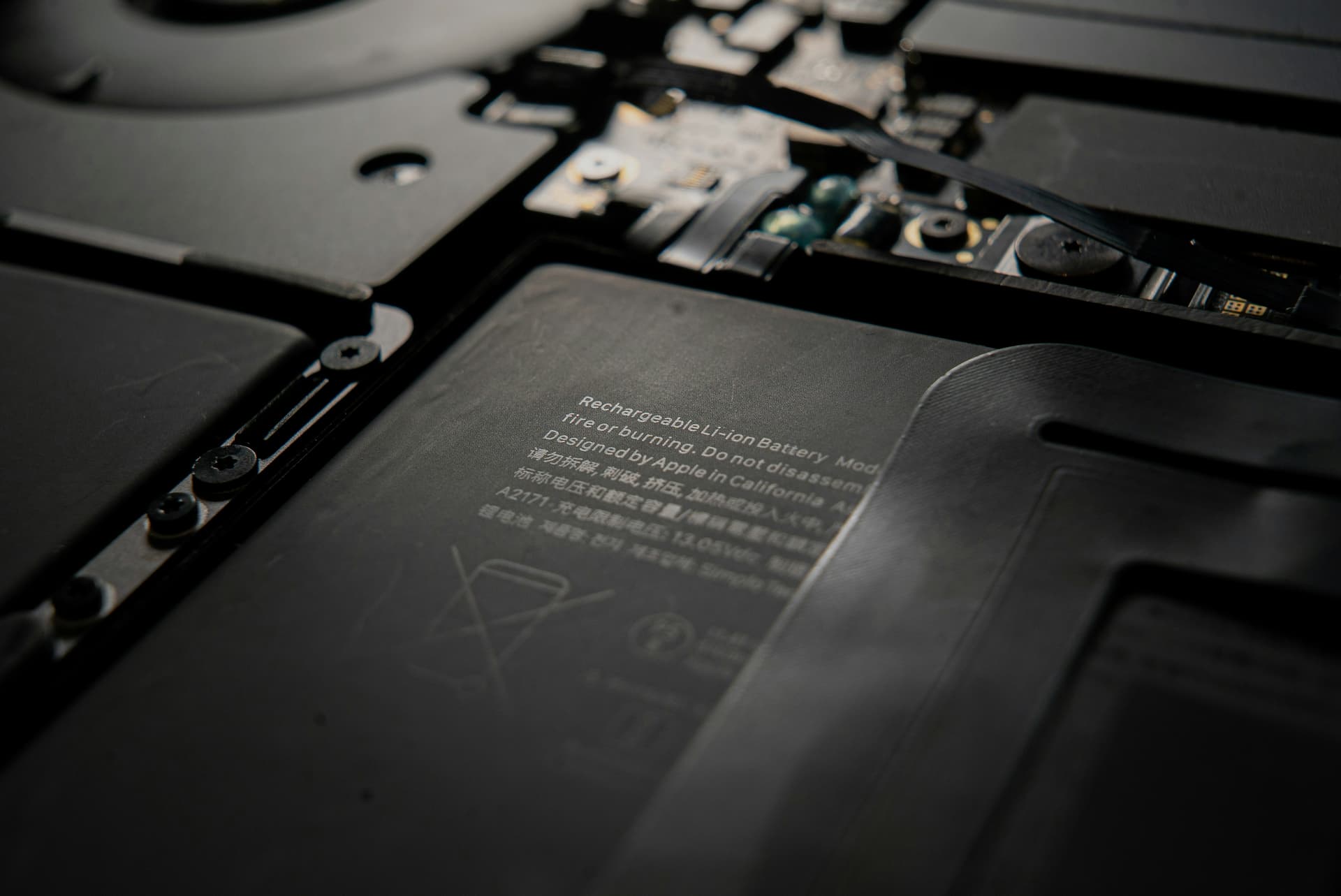
A BMS (Battery Management System) is an electronic circuit board that manages the battery pack and ensures safety. Without a BMS, a lithium-ion battery is dangerous.
What a BMS Does
- Overcharge protection. Each cell must not be charged above 4.2 V (NMC/NCA) or 3.65 V (LFP). Overcharging leads to degradation, swelling, and fire.
- Over-discharge protection. A cell must not be discharged below 2.5-3.0 V. Deep discharge causes irreversible damage.
- Balancing. In a series connection, cells gradually drift apart in voltage over time. The BMS equalises them so all cells remain at the same level. Without balancing, one cell overcharges whilst others remain undercharged — shortening lifespan and creating a hazard.
- Overcurrent protection. The BMS disconnects the battery if discharge current exceeds the safe limit.
- Temperature protection. Temperature sensors disconnect the battery if it overheats (typically above 60-70°C).
- Short circuit protection. Instant disconnection in the event of a short circuit.
What Happens Without a BMS
A battery without a BMS is a ticking time bomb. If overcharged, a cell swells and can catch fire or explode. If deeply discharged, a cell irreversibly loses capacity. If cells become unbalanced, one overloads and fails, taking the rest with it.
Capacity, Voltage, and Discharge Rate
Capacity (mAh / Ah)
The amount of energy a cell can store. Measured in milliamp-hours (mAh) for individual cells and amp-hours (Ah) for battery packs.
Example: a Samsung 30Q cell with 3,000 mAh capacity can deliver 1 A for 3 hours, or 3 A for 1 hour (approximately).
Nominal Voltage (V)
The cell's average operating voltage. For NMC/NCA: 3.6-3.7 V. Fully charged: 4.2 V. Minimum safe discharge: 2.5-3.0 V.
Maximum Continuous Discharge Current (A)
The maximum current a cell can deliver continuously without overheating. This is the crucial parameter for high-power devices:
- High-drain cells (25-45 A): power tools, high-performance e-bikes
- Medium-drain (10-20 A): robot vacuums, electric scooters
- Low-drain (5-10 A): torches, power banks, laptops
There's an inverse relationship between capacity and maximum current: the higher the current, the lower the capacity, and vice versa. The Sony VTC5A delivers 25 A but only 2,600 mAh. The LG MJ1 delivers 3,500 mAh but only 10 A. The choice depends on the device's requirements.
Quality Brands: Whom to Trust
In the world of lithium-ion cells, there's a clear hierarchy. Quality cells are manufactured by just a handful of companies:
Sony / Murata
Sony (cells now produced under the Murata brand following the sale of their battery division) created the first commercial lithium-ion battery (1991). The VTC series is legendary among high-drain cells. The Sony VTC5A and VTC6 remain benchmarks for quality and reliability.
Molicel (E-One Moli Energy)
A Canadian-Taiwanese company whose cells are used in professional equipment. The Molicel P42A (21700) is one of the finest high-drain cells in the world: 4,200 mAh at 45 A continuous discharge. Used in e-bikes, power tools, and racing drones.
Samsung SDI
The world's largest cell manufacturer. A wide range from high-drain (25R, 40T) to high-capacity (50E). Consistent quality, wide availability.
LG Chem / LG Energy Solution
The second-largest manufacturer. LG HG2, LG MJ1, LG M50 are popular models with good quality. Used in electric vehicles, e-bikes, and consumer devices.
Panasonic
Japanese quality. The Panasonic NCR18650GA and NCR21700A are high-capacity cells of excellent quality. Panasonic produces cells for Tesla (Gigafactory joint venture).
Counterfeit Cells and How to Spot Them
The 18650 and 21700 cell market is flooded with counterfeits. This is especially true for popular models: Sony VTC, Samsung 25R/30Q, LG HG2. Counterfeit cells are dangerous — they carry inflated specifications on the label, real capacity may be 2-3 times lower than stated, and safety is questionable.
Signs of a Counterfeit
- Price too low. A quality 18650 cell from Samsung, Sony, or LG costs €3-6. If you're offered a "Sony VTC6" for €1, it's a fake.
- Uneven markings. Original cells have markings applied by laser or high-quality printing. Counterfeits often have crooked, blurred markings that rub off easily.
- No QR code or serial number. Original Samsung and LG cells have individual QR codes. These can be verified on the manufacturer's website.
- Stated capacity exceeds what's physically possible. An 18650 cell claiming 5,000 or 6,000 mAh is a guaranteed fake. The current maximum capacity for an 18650 is approximately 3,600 mAh.
- Weight. A quality 18650 cell weighs 45-50 g. A counterfeit may weigh 30-35 g — there's less active material inside.
Where to Buy
Purchase from authorised distributors (Nkon, IMR Batteries, 18650 Battery Store) or directly from verified suppliers. Avoid cheap cells from AliExpress and eBay — the probability of counterfeits is extremely high.
Safety: Thermal Runaway
Lithium-ion cells contain a flammable electrolyte. If damaged, overcharged, or overheated, thermal runaway can occur — a chain reaction in which the cell rapidly heats up, swells, and catches fire or explodes. Temperatures during thermal runaway can reach 600-1,000°C.
What Causes Thermal Runaway
- Mechanical damage. Puncture, crushing, or dropping from height — damage to the cell's internal structure causes a short circuit.
- Overcharging. Charging above 4.2 V (NMC/NCA) leads to metallic lithium forming on the anode, which can cause an internal short circuit.
- External short circuit. Bridging the cell's terminals with a metal object (a coin or keys in a pocket with an unprotected cell).
- Overheating. Heating above 80-100°C can trigger a chain reaction.
- Poor-quality cell. Manufacturing defects, internal contamination — all increase the probability of thermal runaway.
Safety Rules
- Never carry unprotected cells in a pocket alongside metal objects.
- Store cells in dedicated plastic cases.
- Never charge cells without a BMS or quality charger.
- Don't use cells with a damaged wrapper (dents, cuts, torn heat-shrink).
- If a cell is found to be swelling, immediately isolate it and dispose of it at a proper recycling point.
Battery Pack Assembly and Repair at SATER
SATER also assembles and repairs battery packs from quality Li-ion cells.
What we do:
- Power tool battery rebuilds (Makita, DeWalt, Bosch, Milwaukee, Hilti) — replacing worn cells with new, quality replacements.
- Robot vacuum battery repair — cell replacement in iRobot, Roborock, Xiaomi, and Ecovacs packs.
- Custom battery packs — bespoke battery assembly for specific applications.
We use spot welding (not soldering!) to connect cells — this ensures a reliable contact without overheating the cell. Every pack is fitted with a quality BMS.
Repair path
Where to go next if this fault is repairable
Related SATER service, brand and fault pages help you understand the repair route and get the device into the right diagnostic flow.
Frequently Asked Questions
Need professional repair?
SATER service centre — Silmaču iela 6, Riga
SATER service — home electronics & appliance repair in Riga