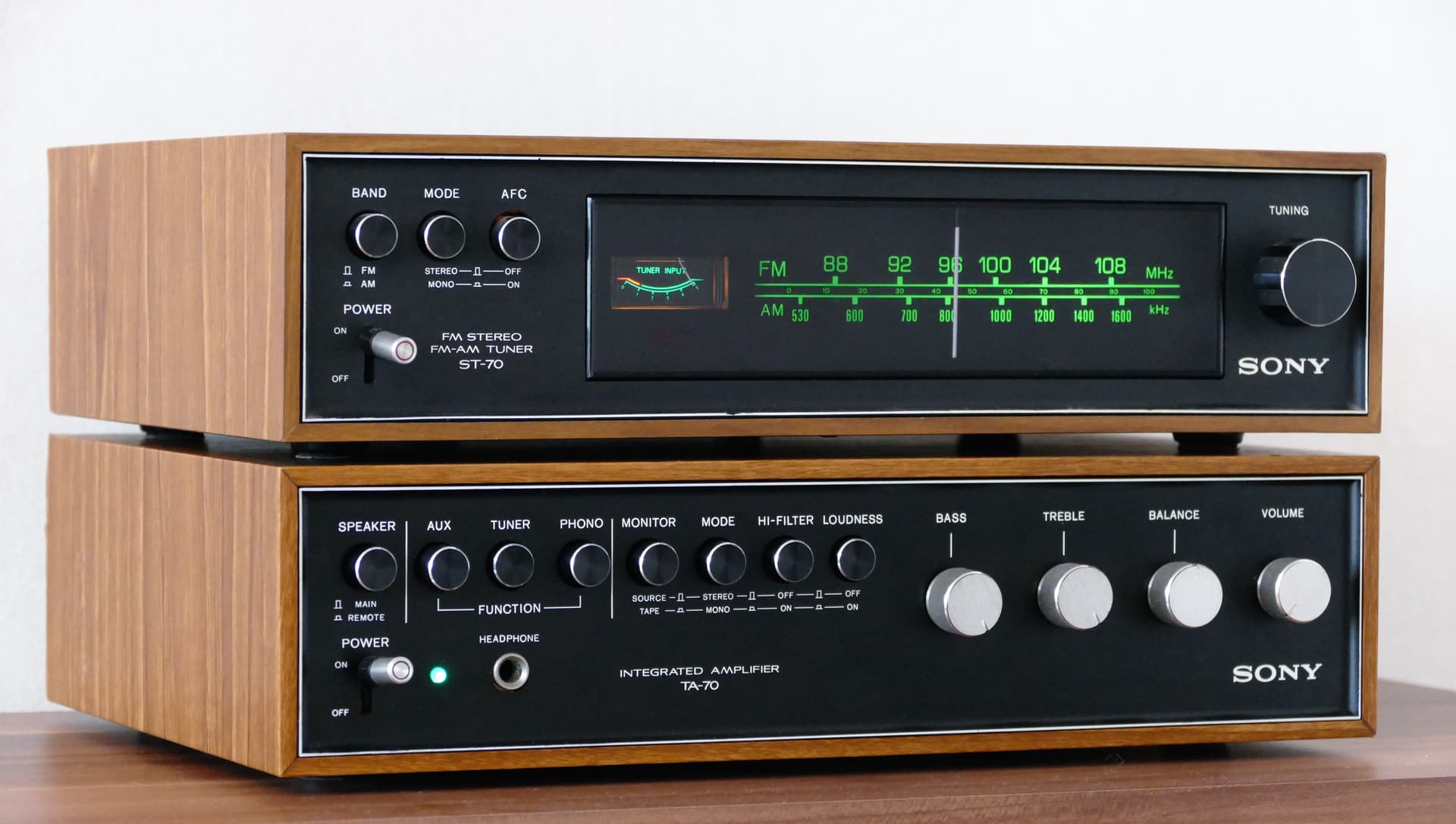

Amplifier Troubleshooting — No Sound, Hum, Distortion, Overheating
Diagnosing amplifier faults: no output, 50 Hz hum, distortion, overheating, popping, crackling. Valve and transistor amplifiers.
Pixabay / Pexels
Contents
The amplifier is the heart of any audio system. When it fails, symptoms range from dead silence to horrible hum, from barely perceptible distortion to smoke pouring from the case. Each symptom points to a specific fault, and correct diagnosis is half the repair.
Amplifier faults can come from power supplies, protection circuits, output stages, controls, solder joints, or dirty connectors. We work with Soviet-era Radiotehnika and Amfiton, modern Denon, Marantz, Yamaha, Cambridge Audio and NAD, plus vintage Technics, Pioneer, and Sansui units.
No Sound at All — Complete Silence
You switch the amplifier on, the indicator lights up, but nothing comes from the speakers.
Possible Causes
Blown fuse. The simplest cause. The main fuse at the power input or channel fuses. A fuse doesn't blow for no reason — it's protecting against something. Replacement with the correct rating may resolve matters, but if it blows again, there's a short circuit somewhere.
Protection mode engaged. Most modern amplifiers have a protection circuit that disconnects the outputs when DC voltage, overload, or overheating is detected. A red "Protect" indicator typically lights or flashes on the front panel. Causes: failed output transistor, short circuit in speakers or cables, DC leakage to the output.
Faulty protection relay. In transistor amplifiers, a relay sits between the output stage and speaker terminals, engaging 2–3 seconds after power-on (a click). If no click, the relay may be faulty: burnt contacts, failed coil, or blown relay driver transistor.
Signal path break. Faulty input selector switch, broken connector, PCB trace break.
50 Hz Hum
Low-frequency hum is one of the most common complaints, particularly with older amplifiers.
Main Causes
Degraded electrolytic capacitors in the power supply. The primary cause. Electrolytic capacitors smooth the ripple after rectification. Over the years, electrolyte dries out, capacitance drops, and the capacitor can no longer filter 100 Hz ripple. In amplifiers over 15–20 years old, this is almost guaranteed.
Ground loop. If hum appears only when certain sources are connected (computer, television), the problem may be a ground loop — two devices on different power circuits with different ground potentials.
Power transformer induction. In some amplifiers, the transformer sits too close to the preamp stage and induces 50 Hz hum electromagnetically.
Solution
Replacing the power supply electrolytics (and signal-path coupling capacitors where needed) is a standard procedure we perform regularly.
Sound Distortion
Sound is present but distorted — especially at higher volume. Instead of clean audio: rasping, harshness, muddiness.
Main Causes
Failed or degraded output transistors. Output transistors (or MOSFETs) operate under heavy loads — high currents, significant heat. Over time their parameters drift, introducing nonlinear distortion. If one transistor from a complementary pair fails, distortion becomes gross and audible even at low volume.
Clipping. If distortion appears only at high volume, the amplifier may be overdriven. Reduce the input signal level.
Incorrect output stage bias. In Class AB transistor amplifiers, the output transistors need a small quiescent current (bias) to minimise crossover distortion. If bias has drifted, characteristic "stepped" distortion appears, most noticeable at low volume.
Overheating
The amplifier is so hot you can't keep your hand on the top cover.
Main Causes
- Insufficient ventilation. Amplifier in a closed niche, other equipment stacked on top.
- Drifted output stage bias. Excessive quiescent current pushes operation closer to Class A, dissipating more heat.
- Short circuit in speakers or cables.
- Dried-out thermal compound. Output transistors are mounted to heatsinks via thermal paste — over the years it dries out.
Popping, Crackling
Main Causes
Dirty potentiometers. The most common cause of crackling when turning the volume knob. Over the years, dust enters, the contact track oxidises, and the wiper begins to jump.
Cold solder joints. Over time, solder joints can crack. A micro-crack creates an intermittent connection.
Faulty capacitors. Electrolytics with leakage can produce periodic pops.
Faulty relay. Oxidised protection relay contacts — intermittent connection.
Solution
Potentiometers are cleaned with DeoxIT D5 — spray inside through the gap, then rotate the control 20–30 times. In most cases this completely eliminates the crackling. Cold joints require resoldering. Capacitors need replacing.
Vintage vs Modern Amplifiers
Vintage (1970s–1990s)
Soviet (Radiotehnika, Amfiton, Brig, Odyssey), Japanese (Technics, Pioneer, Sansui), European (NAD, Cambridge). Typical issues: dried-out electrolytic capacitors, oxidised switches and pots, drifted bias, burnt relay contacts. Often require a full recap and contact cleaning.
Modern (2000s onwards)
Denon, Marantz, Yamaha, Sony. Issues: SMD components (harder to repair), HDMI modules, digital processors. But electrolytics still degrade.
Audio Equipment Repair at SATER
We repair amplifiers, receivers, turntables, and other audio equipment. Older Soviet and Japanese gear often needs capacitor, switch, relay, and solder-joint work; modern AV receivers more often need HDMI, power-supply, or protection-circuit diagnosis.
The important step is to confirm whether the fault is in the amplifier itself, the speakers, cabling, or source equipment.
Repair path
Where to go next if this fault is repairable
Related SATER service, brand and fault pages help you understand the repair route and get the device into the right diagnostic flow.
Frequently Asked Questions
Need professional repair?
SATER service centre — Silmaču iela 6, Riga
SATER service — home electronics & appliance repair in Riga