
Warranty repair or paid repair? How to tell in Latvia
Device broke and unsure if it's a warranty or paid repair? How Latvia's statutory and manufacturer guarantees differ, what's covered, and what to do next.
Contents
Your appliance has failed, and before you call anyone you want to settle one thing: is this a warranty repair or a paid out-of-warranty repair? The answer does not hinge on how old the device is or whether you still have the receipt — it hinges on what caused the fault and which kind of guarantee you actually have. This article explains it from the bench: how Latvia's statutory conformity guarantee differs from a manufacturer's warranty, which faults a guarantee usually does not cover, how to check your remaining term in under a minute, and when a paid repair turns out to be faster and more sensible than the warranty route.
Statutory conformity guarantee vs manufacturer's warranty in Latvia
First, the thing most people confuse: in Latvia you have two separate rights, not one.
The statutory conformity guarantee comes from the Consumer Rights Protection Law. It runs for two years from the date of purchase on any new item bought as a consumer, and it is given by the seller (the shop), not the manufacturer. This is the one that matters most: if a product becomes unfit for use within the first two years because of a manufacturing or material defect, you raise the claim with the shop where you bought it, and the shop is liable for it — not SATER, not any other service centre.
The manufacturer's (commercial) warranty is a voluntary extra promise from the manufacturer or seller. It might be one year, it might be five, it might cover only the compressor or only the panel. It sits on top of your statutory rights, not in place of them — so even if the manufacturer's warranty is only 12 months, you still keep the two-year statutory protection against the seller.
Swipe to see the full table
The practical order is simple: if the device is under two years old and has failed on its own, go to the shop first, not to a paid service. If the guarantee does not cover the specific fault, or the term has run out, then the paid-repair conversation begins. That line between "warranty repair or paid repair" is exactly what we help you draw here.
Important note on second-hand goods. If you bought from a private individual (ss.lv, Marketplace), the statutory conformity guarantee does not apply — it only covers a purchase from a trader. In that case a paid repair is often the only route, and that is normal.
Which faults a guarantee usually does not cover
This is where people go wrong most often. A guarantee — statutory or manufacturer — covers a manufacturing defect, not every kind of damage. From the bench we see that a large share of "warranty" cases are really the result of use or external damage that no shop will cover:
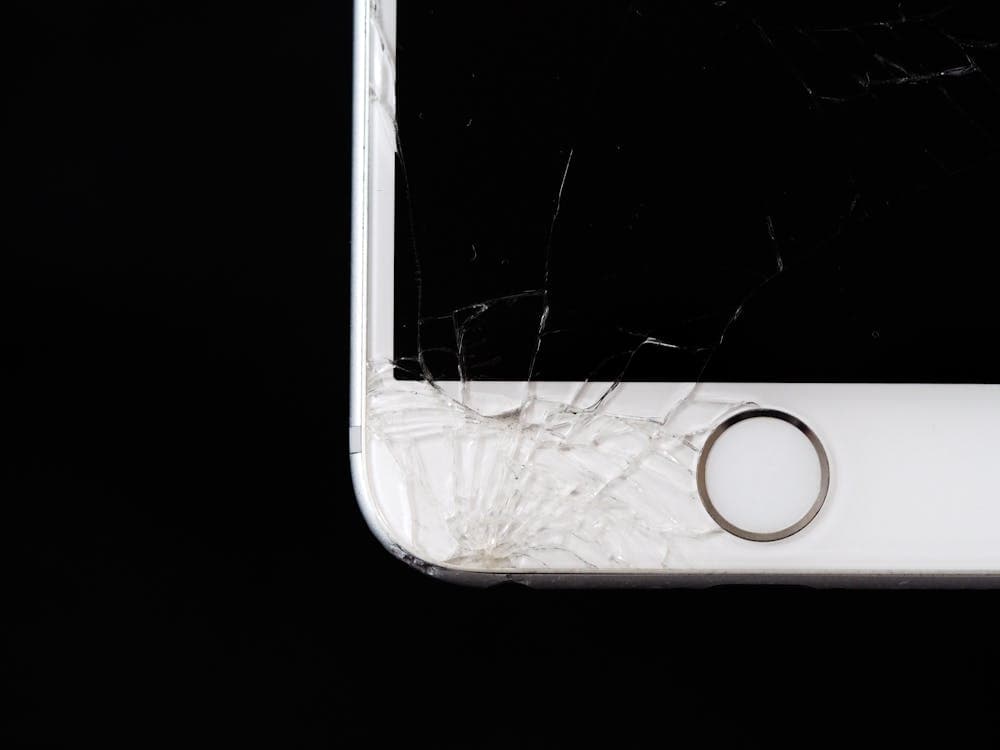
- Mechanical damage. A dropped TV with a cracked panel, a crushed vacuum housing, a snapped iron lever. A crack in the glass or the screen almost always voids the guarantee — it is visible at a glance.
- Liquid or moisture damage. A drink spilled over a remote, a leaking juicer, condensation inside the electronics. Many devices carry moisture indicators that change colour permanently.
- Surges and incorrect connection. A mains surge burns out the power supply or a control board. In older Riga buildings with tired wiring this happens more often than anyone would like.
- Wear and consumable parts. Vacuum brushes, a battery's capacity decline, mixer carbon brushes — these wear down naturally and are usually not covered.
- Clogging and poor maintenance. A steam iron scaled up inside, an unchanged extractor-hood filter, a microwave magnetron burned out from being run empty.
- Unauthorised prior intervention. If someone has already opened the casing, broken the warranty seals, or fitted non-original parts — the guarantee falls.
Swipe to see the full table
An honest warning: a service that handles warranty repairs on the manufacturer's behalf will write up a report on the cause of the fault, and if it is mechanical or liquid damage the guarantee will be refused — even if the term is still valid. That is not a service "cheating" you; it is the real line between a defect and damage.
How to check whether your device is still under guarantee
Before any conversation, get the facts straight. It takes a few minutes and saves a wasted trip.
- Find the purchase date. The statutory term runs from purchase, not from manufacture. A receipt, a bank statement, an email confirmation from an online shop, or even the purchase history in the shop's app — all of these work as proof.
- Find the warranty card or conditions. The manufacturer's warranty term and its limits (e.g. "2 years on the device, 10 years on the motor") are on the card or on the manufacturer's site by model number.
- Read off the model and serial number. The label is on the back or underside of the device. With the serial number you can often check the exact warranty status and manufacture date on the maker's site.
- Count the term. Under 2 years from a trader purchase → statutory guarantee in force. Older → only the manufacturer's warranty remains, if one was promised for longer; otherwise it is a paid repair.
- Check the seals and indicators. If a warranty seal is broken or a moisture indicator has gone red, the guarantee route is most likely closed regardless of the term.
A practical tip: if the receipt is lost but you paid by card, a bank statement showing the shop name and amount is accepted as proof in Latvia. Do not drop a claim just because the paper receipt is gone.
When a paid repair is faster and more sensible
Even when the guarantee is technically in force, it is not always the better route. From experience there are several situations where a paid repair solves the problem faster and with less hassle:
- The guarantee does not cover this fault. If the problem is mechanical, liquid, or surge-related, the warranty claim will end in a refusal report — and you will have lost weeks reaching the same paid repair anyway.
- The warranty service is far away or slow. Some manufacturers ship the device to a central service outside Riga, or even outside Latvia; the repair can drag on for weeks. A local service often returns the device sooner.
- A consumable part that is not covered anyway. A battery rebuild, worn carbon brushes, a new brush roller — none of these are warranty cases by their nature, so the paid route is the direct one.
- An older but good device. Once the two-year term has ended, the choice is only between a paid repair and a new purchase — and for quality equipment a repair is often the cheaper path.
- Second-hand equipment with no statutory protection. A purchase from a private individual — a paid repair is the only realistic option.
The decision logic is simple: if the fault is a defect and the term is in force, go to the guarantee first, because it costs you nothing. If even one of those conditions is not met, there is no point spending time getting a warranty refusal on paper — better to go straight to diagnostics.
Whether the equipment is even worth repairing is a separate question; for that it is worth reading how to choose a repair service, so the paid repair goes to a place that gives you a document and stands behind its own work.
What to prepare for a claim against the seller
If you have concluded it is a warranty case and you are heading to the shop, prepare — a well-presented claim is resolved much faster.
- Proof of purchase. A receipt or bank statement showing the date, shop name, and amount.
- The warranty card (if there was one) and the device's model/serial number.
- A short, factual description of the fault. "After 4 months the TV shuts off by itself and restarts repeatedly" is better than "it broke". Add a photo or a short video of the symptom.
- A written claim. In Latvia the seller is obliged to give a written response within 15 working days. Submit the claim in writing (email is fine) and keep a copy — it keeps the process on track.
- Keep the handover document. When you leave the device, take a record with the date and a description of what you handed in. Without it you have nothing to prove later.
If the seller refuses without grounds, the claim can be escalated to the Consumer Rights Protection Centre (PTAC). For more on your right to a repair and what the manufacturer and seller must provide, read the EU right to repair.
In the first six months the law is especially strongly on your side: the defect is assumed to have existed at the moment of purchase, and the seller must prove otherwise, not you. After six months the burden of proof can shift to you, so do not delay the claim.
Repair path
Where to go next if this fault is repairable
Related SATER service, brand and fault pages help you understand the repair route and get the device into the right diagnostic flow.
Frequently Asked Questions
Need professional repair?
SATER service centre — Silmaču iela 6, Riga
SATER service — home electronics & appliance repair in Riga